
Image Missing
grand tours
Getting to know...
Phia Thap is a small village in Quang Uyen district, Cao Bang province, home to the Nung An people - a sub-group of the Nung ethnic minority who migrated from southern China centuries ago. The village sits in a karst limestone valley with dramatic peaks rising on all sides, surrounded by rice paddies and subtropical forest. It falls within the Non Nước Cao Bằng UNESCO Global Geopark, recognised in 2018.
No one can remember exactly when incense production started here, but the rough consensus is around four hundred years ago. Today, approximately 50 families in the village are involved in making incense entirely by hand. The craft was recognised as a national intangible cultural heritage by Vietnam’s Ministry of Culture. Walking through the stone-walled paths between the traditional stilt houses, with bundles of brightly coloured incense drying in the sun on every available surface, it feels like a village that has barely changed in centuries.
Incense production
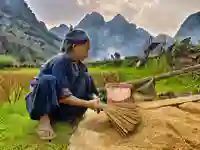
The entire process happens in the village from start to finish, using only locally sourced materials. Bamboo is harvested for the sticks - split and trimmed to size by hand. The bark of the bầu hắt tree (a local aromatic species) is dried and ground into a fine powder that gives the incense its fragrance. Natural plant-based glues bind the powder to the bamboo sticks, and natural dyes give them their distinctive colours - reds, yellows and pinks.
The sticks are rolled and coated by hand, then laid out in huge bundles to dry in the sun on bamboo racks or spread across the ground. This is the scene that everyone photographs - hundreds of colourful sticks fanning out against the backdrop of stone walls and stilt houses. Production runs year-round but intensifies before Tết (Lunar New Year) and festival periods when demand for incense peaks across Vietnam.
What makes Phia Thap incense special is the recipe - entirely natural, no industrial chemicals, using methods unchanged for generations. The incense burns slower and more fragrant than factory-produced alternatives.
The Nung An people
The Nung An are part of the broader Nung ethnic minority, one of Vietnam’s larger ethnic groups concentrated in the northeastern provinces bordering China. They have a rich tradition of folk songs known as sli and lượn, performed at festivals and gatherings. Incense is not just an economic activity - it is deeply tied to Nung spiritual life, burned during ancestor worship, at shrines, during Tết and at funerals.
The village architecture is distinctly Nung - timber stilt houses with tiled roofs, raised living quarters above and storage below, connected by paths lined with dry stone walls. The stone walls are a characteristic feature of Nung villages in this region and give Phia Thap much of its charm.
Visiting
We stop in Phia Thap as part of our grand tours through the Cao Bang region. You can watch the full production process, walk through the village and chat with the families. If you would like some of these unique incense sticks to take home and support the local villagers directly, they are only too happy to sell you some.